How to start an online casino in Peru: a complete 2026 gambling industry overview
Ask ten operators why they're looking at Peru right now, and you'll hear some version of the same answer: the paperwork finally makes sense. For years, figuring out how to start an online gambling site here meant navigating rules that simply didn't mention online gaming. That's no longer true, and it changes the calculation for anyone considering Peru as a gambling market.
Our team has spent the last several years building and troubleshooting gambling platforms across Latin America — payments, licensing paperwork, game integrations — and Peru keeps coming up as one of the more sensible entry points on the continent. This guide walks through what we've learned: the rules as they actually stand today, what a license application involves, which technology and payment choices matter, and who you're actually building a product for.
Peru's gambling boom: El Milagro Peruano and the state of the market

Start with the country itself. Peru is South America's third-biggest nation by land area, and through the 2000s and 2010s it earned a nickname — "El Milagro Peruano" — for pulling off a run of GDP growth and poverty reduction that outpaced most of its neighbors. Trade deals, a privatization wave, and a more diversified economy did most of the heavy lifting; and while political instability and the pandemic have since tested that record, the underlying fundamentals haven't collapsed.
One thing that wasn’t fixed quickly was internet access. Roughly seven in ten urban Peruvians are online today, but that number drops closer to four in ten once you leave the cities, out of a population pushing 34 million. The government launched a connectivity push a few years ago to close that gap, and every point that initiative closes is effectively a new addressable market for anyone running an online gambling business here.
None of that matters much if the appetite for betting isn't already there — and in Peru, it certainly is. Regional surveys tend to rank the country just behind Argentina for onshore gambling participation and just behind Brazil for overall betting activity, with a large share of adults having placed a bet at some point; and a smaller but still substantial group doing so regularly. Football drives most of that action, although slots and table games still hold their own.
It also helps to know how competitive the market is before you step into it. Peru is usually named alongside Argentina, Brazil, and Colombia as one of the four biggest gambling markets in Latin America, a status built on decades of land-based infrastructure — casino floors, slot halls, betting counters — that predates any conversation about online gambling regulation. Industry estimates place pre-pandemic land-based revenue above a billion and a half dollars annually. When lockdowns shuttered those venues, bettors who could get online, did. And that migration toward online casino products hasn't stopped since restrictions in Peru were lifted.


How is online gambling regulated in Peru? From gray market to a modern iGaming framework
If you had asked how online gambling is regulated in Peru even five years ago, the honest answer was that it barely was. Land-based casino law dated to the 1990s and simply didn't contemplate remote betting. That gap has since closed, and understanding exactly how it closed is the most important piece of homework you can do before you start an online casino business in Peru.
The land-based foundation
The older framework traces back to a pair of decree-laws from 1979 and was later formalized under Law No. 27153, which governs casino games specifically. Oversight sits with the General Office of Casino Games and Slot Machines, a body inside the Ministry of Foreign Trade and Tourism — MINCETUR, in the shorthand everyone in the industry uses. Getting licensed means passing a background check aimed at keeping organized crime out of the sector, and once granted, a license runs for a set number of years with the option to renew. Operators owe 12% of gross gaming revenue in tax. Roulette, blackjack, punto banco, poker, bingo, and slots are all approved formats, and for what it's worth, nothing in the older rules ever stopped Peruvians from playing on offshore sites licensed out of Curaçao or Malta — which is part of why the online rules eventually became unavoidable.
Potential iGaming regulations become reality
Here's where gambling regulations in Peru get genuinely interesting, and where a lot of outdated articles online get the story wrong. Congress passed Law No. 31557 in mid-2022, and it was signed that August — but the original version had an obvious flaw: it only taxed operators with a Peruvian home base, which meant foreign competitors could undercut local ones simply by staying offshore. Industry pressure led to a fix, Law
No. 31806, in 2023. That amendment closed the tax loophole, roughly tripled the required licensing guarantee, and did away with retail-only licenses altogether. The technical rulebook — Supreme Decree 005-2023-MINCETUR — followed later in 2023, and the whole system became legally binding on February 9, 2024. That made Peru the third country in South America to fully regulate online gambling, after Colombia and Argentina got there first. So if you’re wondering how online casinos are regulated in Peru as of today, here is a brief summary:
- A single six-year license from MINCETUR covers both online casino products and sports betting — there's no need to apply separately for each
- Net gaming revenue is taxed at 12%, with the proceeds split four ways: 20% to the public treasury, 20% to the Ministry of Health for mental health programs, 40% to MINCETUR itself (covering both enforcement and tourism promotion), and 20% to the Peruvian Sports Institute (IPD) for national sports development
- Every platform and every game has to pass certification through an accredited testing lab before it can go live
- Hosting servers outside Peru is allowed, but MINCETUR needs real-time access to certify them and to pull player and prize data on demand
- Betting with cryptocurrency isn't permitted — wagers have to move through conventional payment channels
- Physical betting locations cannot sit within 150 meters of a school, and sponsorship or advertising is restricted to licensed brands only
- Operating without a license risks fines that can climb past PEN990,000 (€254,076/$289,257 as of July 2026), plus potential criminal exposure for the executives responsible
When the licensing window opened between February and March of 2024, MINCETUR logged 145 operator applications, another 144 service-provider registrations, and 184 requests to approve specific platforms or games — a clear signal of just how much interest there already is in online gambling licenses in Peru. That volume of early applicants is also exactly why getting your paperwork right the first time matters more here than in less competitive markets.
Tips on how to start an online casino business in Peru
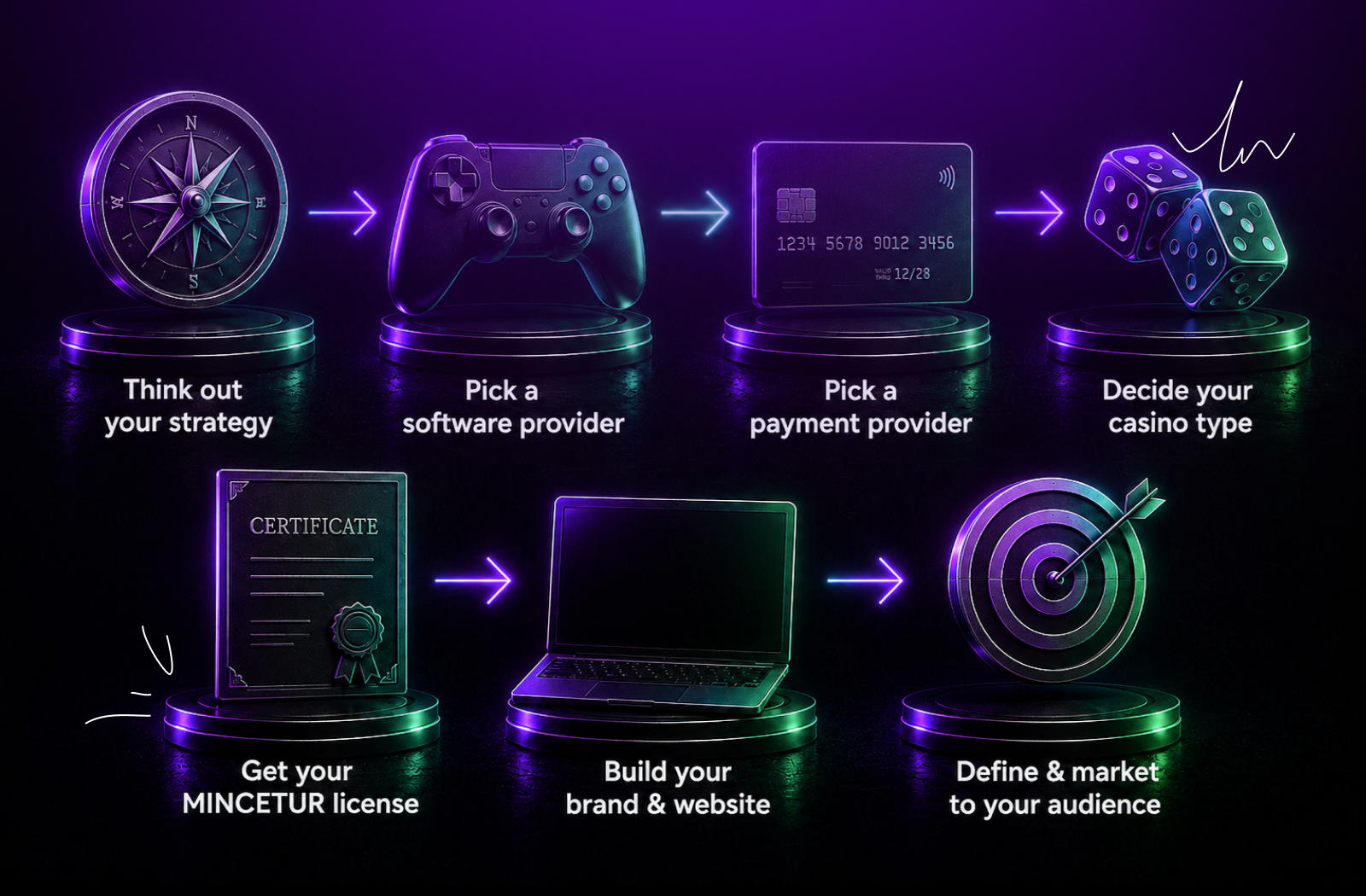
Knowing the rules is only step one. The second step is starting a betting and casino site that can actually hold its own once you're live. Peru's status as one of the region's four biggest markets cuts both ways — real demand, but also real competition – and a persistent minority of operators who would rather skip licensing than deal with it. Treat licensing as leverage rather than red tape, because it's one of the clearest ways to separate your brand from the unlicensed noise.
1. Think out your strategy thoroughly
Before any money moves, get honest about what you're actually building:
- Capital requirements are steep — the licensing guarantee alone runs into six figures before you've spent a dollar on a product
- Your game and betting catalog needs a reason to exist beyond copying whatever's already popular
- Your back-end — payments, identity verification, security, reporting — has to satisfy MINCETUR's real-time data rules from day one, not eventually
- Your marketing plan needs to be built for Peruvian players specifically, not lightly translated from a European or North American template
Most of the operators who stumble here didn't skip this step maliciously — they just assumed it could wait. It can't.


2. Decide what type of casino you want to start
Peru's place among the region's four biggest gambling markets means there's room for more than one business model, but you still need to commit to one. A Peruvian online casino built around slots, roulette, and bingo pulls a different crowd than a sportsbook anchored in football and horse racing — plenty of operators eventually run both, but almost none start that way.
Competition among casino sites in Peru is real, and a chunk of that competition operates without a license at all, which makes a clear point of difference worth more than it might elsewhere. A live-dealer focus, a compliant crypto-adjacent wallet experience, or simply a deeper sportsbook than anyone else offers — any of these beat trying to out-generate the generic online casinos already crowding the space in Peru.
3. Pick a trusted gambling software provider
This choice ripples through everything downstream, so give it real time. There are essentially two paths. The first is building your own platform: hiring a development team and negotiating with several game providers separately. The second is buying a ready-made platform from a B2B provider and plugging into a single aggregator instead.
The first option almost always turns out slower and more expensive: you need your own team, and every individual game provider means a separate contract and a separate integration to manage. The second option is faster and cheaper — all the analysis, backend/frontend development, and provider negotiations have already been done for you, so you just plug into a solution that's ready to go.
APIgrator, for instance, lets you stock a casino platform with over 20,000 certified games from more than 150 licensed developers — all through a single integration.
4. Get a license for legal business operation
This is the step where a real business parts ways with targets for law enforcement. Peru's ranking among the four giants of the gambling industry comes with real competition, and that competition tempts a fair number of operators into launching illegally rather than dealing with MINCETUR's process. It's a bet that rarely pays off — fines, site blocking, and personal criminal exposure for company officers are all on the table.
Getting a license for an online casino or sports betting site in Peru means applying directly through MINCETUR, posting a substantial financial guarantee, sending your platform out for lab certification, and proving you can report to both MINCETUR and Peru's tax authority in real time. It's a heavier lift in Peru than in some neighboring countries, but that's precisely what makes a casino license worth having — it tells players, banking partners, and payment processors that you aren’t cutting corners.
5. Pick a payment service provider
Payment methods in Peru don't map cleanly onto what works in Europe or North America, and getting this wrong quietly caps your conversion rate before you even notice. Roughly half of Latin American adults have a bank account at all, and credit card ownership is lower still — so while VISA, Mastercard, and Amex remain necessary, cash-voucher systems like PagoEfectivo carry just as much weight in practice. A player generates a code, pays in cash at a partner location, and the operator can still price everything in soles while settling in dollars behind the scenes.
Rather than negotiating and maintaining a separate contract for every single payment rail, most operators route through a gambling payment aggregator — one integration that bundles dozens of local and international payment methods behind a single connection. That one decision alone can shave months off your engineering timeline and cut ongoing compliance headaches considerably. Moneygrator, for example, brings together 250 payment systems spanning multiple gambling markets into a single integration session, cutting out the back-and-forth of negotiating each one separately.
6. Identify your target audience and market your games to them
Everything from your game selection to your bonus structure should trace back to a clear picture of who you're serving — location, age, device habits, preferred payment method. Let that data steer where your marketing budget actually goes, across social, affiliate, and influencer channels, instead of guessing and hoping.
Popular sports for betting. If sports betting is part of your plan, then you need to understand the landscape. Football accounts for the overwhelming majority of betting volume, and tournaments like the World Cup, Champions League, and Copa América reliably spike activity. Horse racing has serious history behind it too — Lima's Hipódromo de Monterrico has run races since 1960, with bettors able to wager on track, at off-track counters, or online. Basketball, volleyball, and tennis fill out the rest of the popular sports in Peru worth building odds around.
Final recommendations before you launch
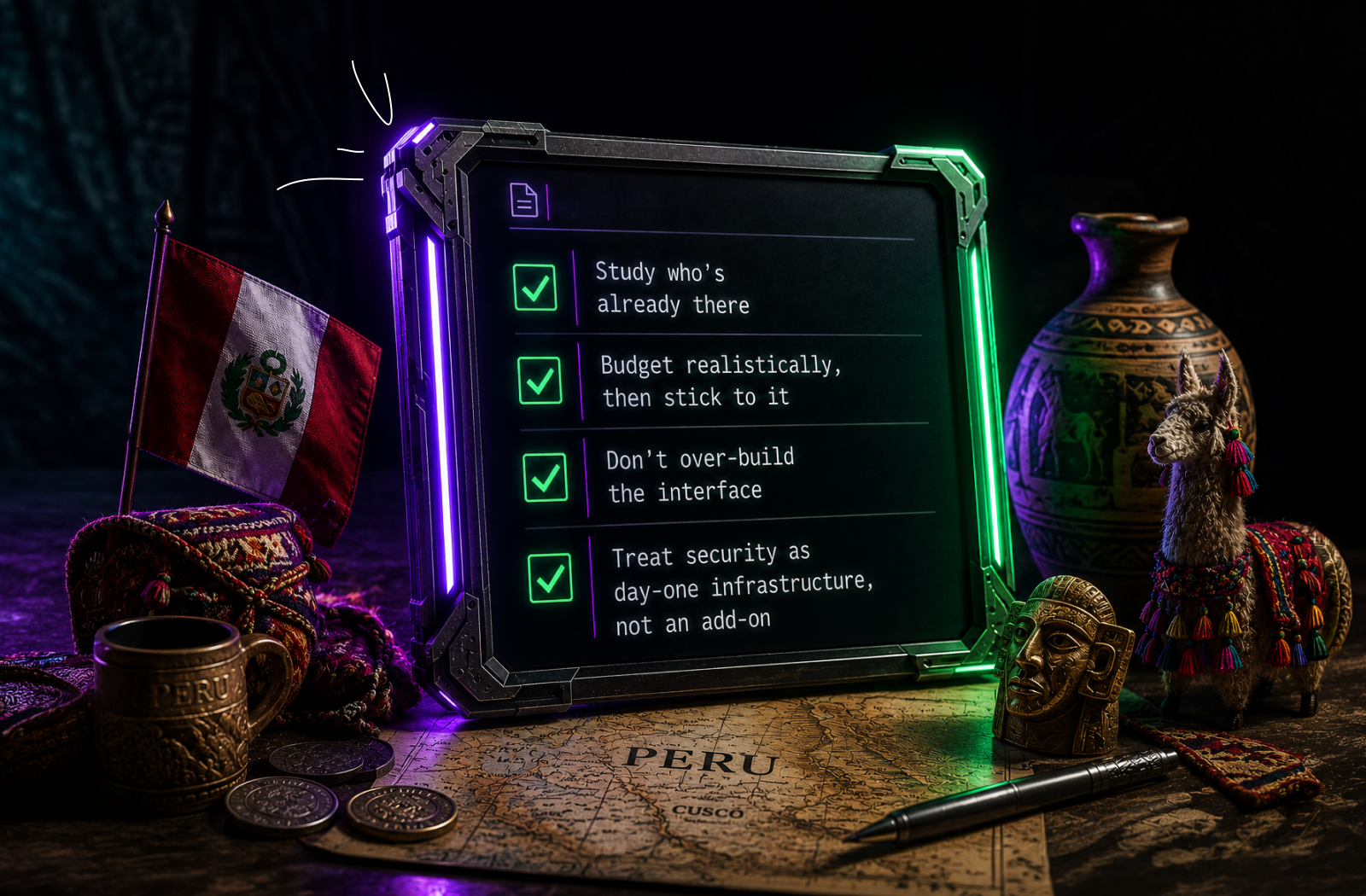
A handful of extra lessons tend to separate the launches that stick from the ones that stall:
- Study who's already in Peru. Map the existing sports betting and casino sites well enough to know exactly where their product falls short — that gap is usually your opening.
- Budget realistically, then stick to it. Underfunded operators tend to run dry right when acquisition costs peak, typically within the first six to twelve months.
- Don't over-build the interface. Speed and clarity beat visual polish nearly every time; slow or cluttered mobile experiences lose players before they've placed a single bet.
- Treat security as day-one infrastructure, not an add-on. Gambling platforms are a frequent fraud and cyberattack target, and given MINCETUR's real-time reporting rules, weak security quickly becomes a compliance problem as much as a financial one.
The present and future of online gambling in Peru
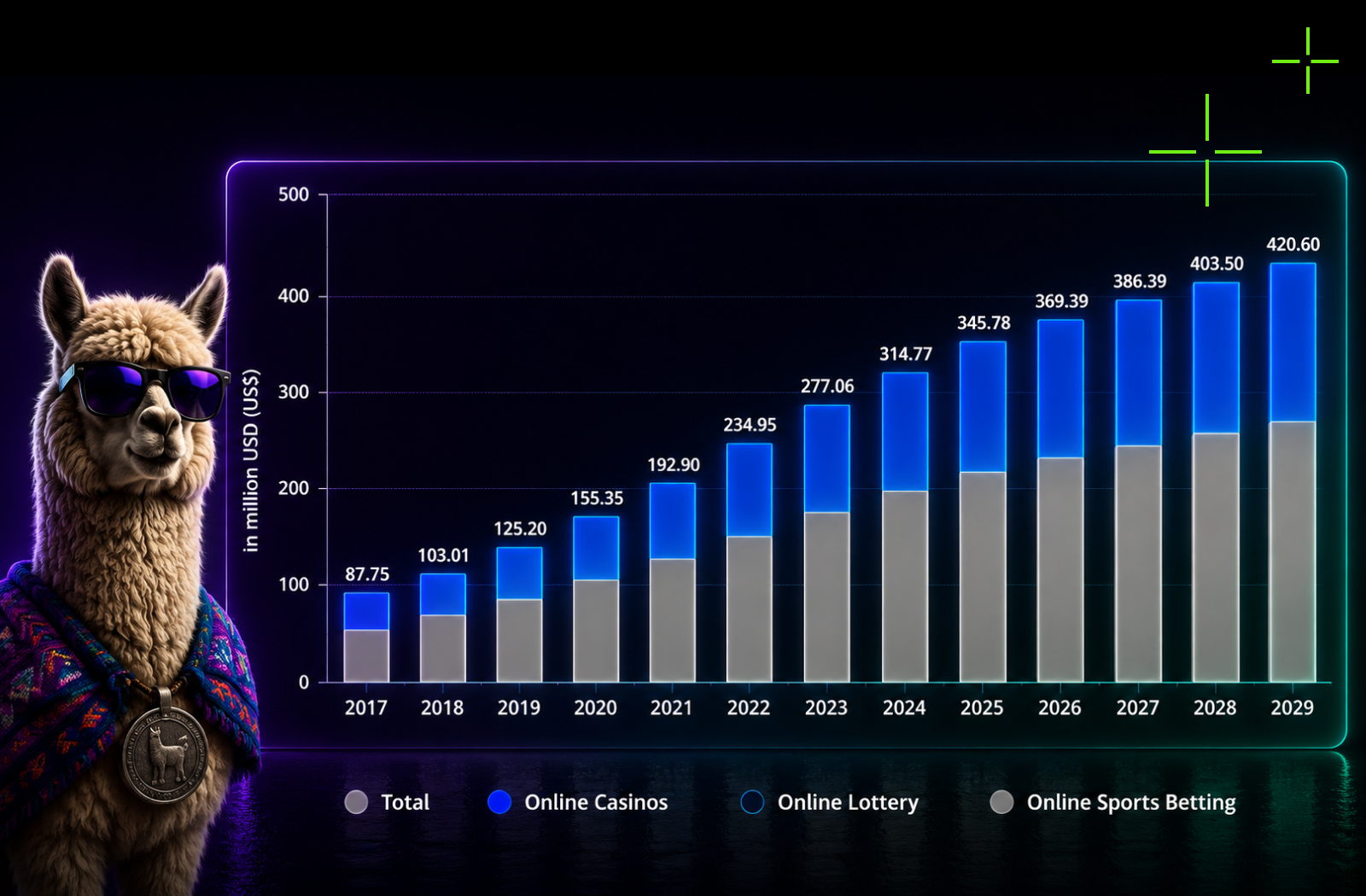
Now that the regulatory framework is fully in force, the interesting points have shifted from "this might get legalized" to "who executes it best?" A few things worth keeping an eye on:
Crypto casinos in Peru are still boxed in. Direct wagering in cryptocurrency isn't allowed under current rules, so any blockchain-based loyalty program or crypto-to-fiat on-ramp you're considering needs to stay firmly on the compliant side of that line. That could shift as neighboring markets loosen their own crypto casino rules, but it's not something to bank a business plan on today in Peru.
Mobile isn't a secondary channel anymore. As connectivity keeps spreading into rural areas, betting apps in Peru are becoming the primary channel, overtaking Peruvian casino websites. Operators treating their app as an afterthought are already losing ground to mobile-first competitors.
Bonuses have become a real battleground. With dozens of freshly licensed brands in Peru chasing the same players, betting bonuses offers — welcome packages, cashback, tiered loyalty programs — are one of the most visible ways operators try to stand out. Just keep your terms inside MINCETUR's responsible-gambling and advertising rules, which are considerably tighter than they were during the unregulated years.
Expect the field to thin out. Not every one of the 145-plus applicants from the 2024 online gambling licensing window will still be around in a few years. Smaller or less capitalized operators tend to get absorbed or exit; while compliance-first, well-funded brands end up holding more of the market.
Conclusion
And that’s how to start an online casino business in Peru! The country has gone from gray-market ambiguity to one of the more clearly defined iGaming jurisdictions in Latin America, and that shift is exactly why the timing works in an operator's favor right now. There's proven demand, a football-obsessed betting culture, decades of land-based infrastructure to build on, and a licensing system that — as demanding as it is — gives compliant operators a real edge over unlicensed competitors.
We've seen the same pattern play out across every Latin American market we've worked in: the operators who treat licensing, payments, and player experience as one connected system, rather than three problems to solve in sequence, are the ones still standing three years later. With the right strategy, software partner, payment stack, and the license application in place from the start, Peru has some of the best potential for durable growth in the region right now.
FAQ
How to open an online casino in Peru?
Apply for your license directly through MINCETUR, meet the financial guarantee requirement, have your platform and games certified by an accredited testing lab, and build out the real-time reporting connection the regulator requires. Working with an experienced software and payment partner tends to cut this timeline down substantially.
What sports are popular in Peru?
Football (soccer) drives the large majority of betting activity, with horse racing, basketball, volleyball, and tennis making up most of what's left.
Who regulates online casinos in Peru?
MINCETUR — the Ministry of Foreign Trade and Tourism — through its General Office of Casino Games and Slot Machines, licenses and supervises both land-based and online operators under Law No. 31557, as amended by Law No. 31806 and detailed further in Supreme Decree 005-2023-MINCETUR.
How much does it cost to open a casino in Peru?
There's no single figure, since costs scale with the business model, but the recurring line items look like this:
- Licensing guarantee. Since the 2023 amendment to Law No. 31557, the required guarantee for an online license is whichever is greater: 3% of projected annual net income, or 600 UIT — somewhere around PEN2.97 million, or roughly $780,000 at recent exchange rates. Land-based casino licensing costs far less, though fees and audits still add up to tens of thousands of dollars.
- Platform and website build. A custom platform can run from the low tens of thousands of dollars for a lean setup, to hundreds of thousand for something fully bespoke with proprietary game content.
- Payment and compliance systems. Integrating a gambling payment aggregator, identity-verification tooling, and reporting infrastructure that satisfies both MINCETUR and SUNAT is a line item for new operators consistently under budget.
- Marketing and acquisition. Given how crowded casino and sports betting have become in Peru, expect a serious first-year marketing commitment for a real regional push.
Taken together, most well-capitalized launches plan for somewhere between one and two million dollars in year one, though partnering with an established software provider on a white-label basis can bring that number down meaningfully by reducing the technology and licensing burden.

Leave a comment