Find what works well
Contact our team to get a professional recomendation about what vertical and business model is the most suitable according to your goals, resources, and a chosen market of operation.
In recent years, sweepstakes casinos have surged in popularity, especially in markets with strict anti-gambling laws. In 2024, US players alone generated approximately $3.4 billion in net revenue. Despite the vertical’s ambiguous regulatory status, growth shows no signs of slowing down. Sweepstakes casinos have positioned themselves as a safe, flexible, and lucrative alternative to traditional real-money gambling, opening up new opportunities for both players and operators.
Let’s take a closer look at this quickly growing phenomenon to understand its true potential.
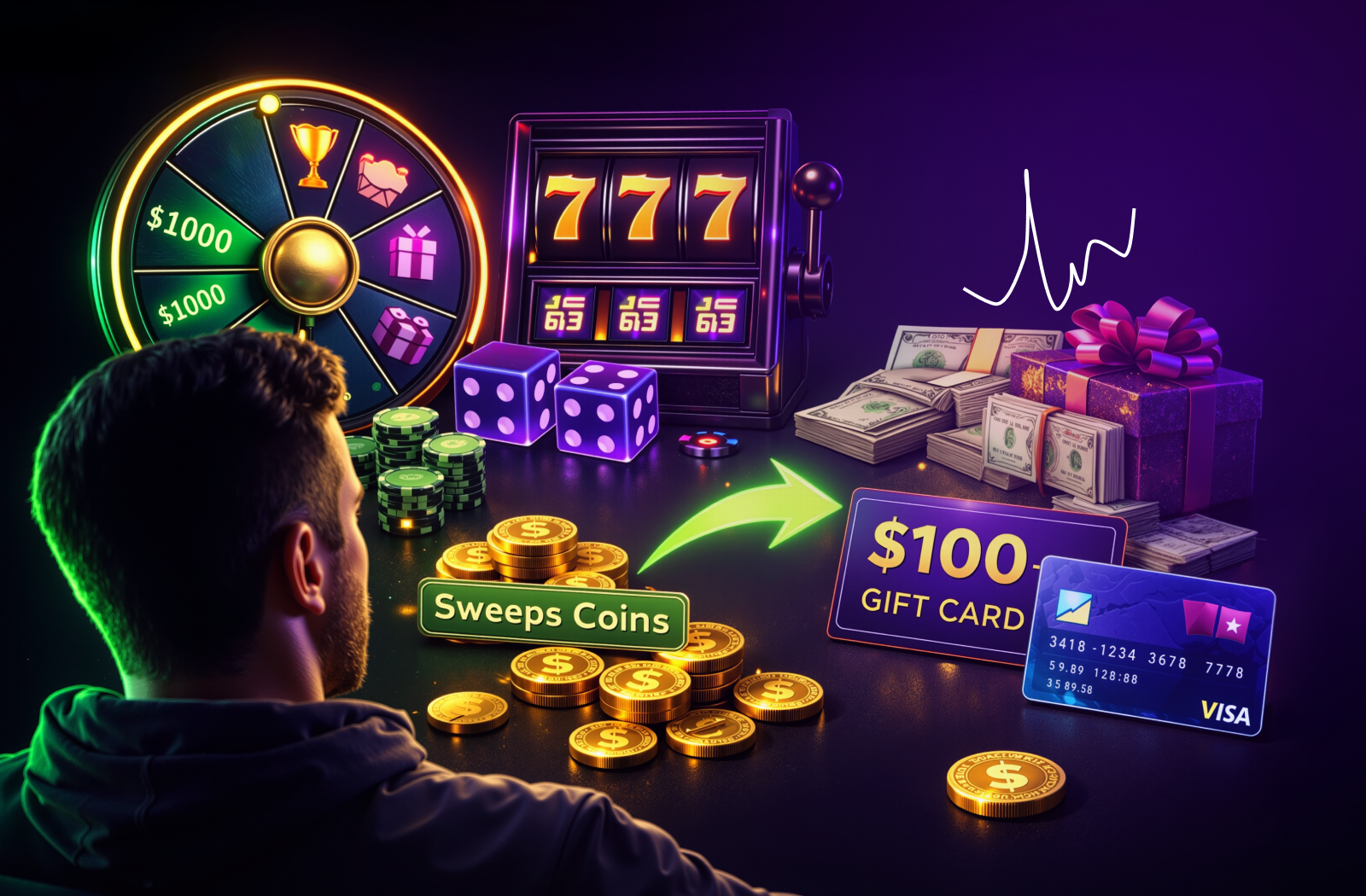
Sweepstakes casino is an online gaming platform that looks and feels like a traditional casino, but operates under promotional sweepstakes laws rather than gambling laws. They originate from decades-old US promotional contest rules that allow anyone to enter and win a prize without requiring players to wager real money, so they're not legally considered gambling.
The design, functionality, and mechanics mirror a typical casino. Players can sign up for free or with a subscription and play casino-style games (slots, poker, blackjack, etc.) with virtual fun currency, often called Gold Coins or Play Coins. They don’t have real cash value and are used entirely for fun.
The most important here is the dual currency principle: sweepstakes casinos offer two types of currencies, with the second type tied to actual prizes or sometimes cash. Players can win special Sweeps Coins when they play or buy virtual fun currency. Sweeps Coins are a separate virtual currency that can be redeemed for real prizes (cash, gift cards, merchandise) according to a platform’s rules.
The dual currency system and no direct purchase requirement put sweepstakes casinos in an ultimately different legal realm, allowing them to offer games legally in many markets where gambling is restricted.
Another compelling aspect of this form of entertainment is its strong social element. Sweepstakes casinos feature leaderboards, chat rooms, and ways to connect and share achievements, turning gameplay into a shared experience with a sense of friendly competition. This supports engagement and retention, giving players more reasons to stay — not for the slim chance of a big payout, but for the ongoing fun and interaction.

Contact our team to get a professional recomendation about what vertical and business model is the most suitable according to your goals, resources, and a chosen market of operation.
By theme and games, social casinos may belong to the same family, but they are entirely different. Social casinos are strictly entertainment-only casino games with no real-money prizes. Players can buy or receive virtual coins or chips that they can spend to play casino-style games, such as slots, dice, roulette, or card games. There’s no mechanism to exchange them for real money or prizes.
The emphasis is on the joy from the games and social interaction: just like sweepstakes casinos, social casinos normally offer a variety of ways to connect with other players for a shared experience. In their business model, they are similar to mobile or Facebook apps, with no options to cash out winnings.
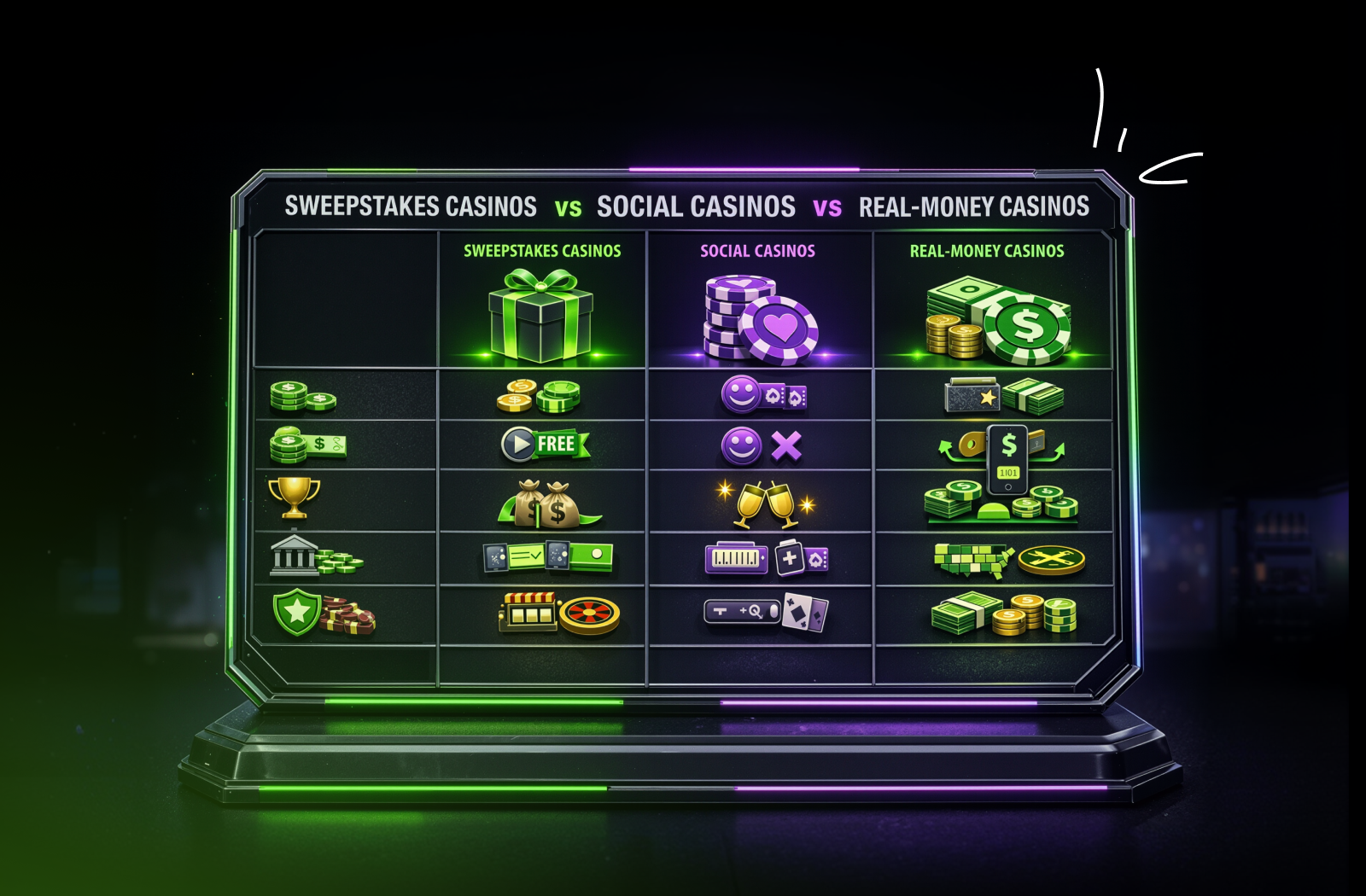
Therefore, sweepstakes casinos occupy the space between social casinos and real-money online gambling. Like social casinos, they are free to play and primarily entertainment-focused. At the same time, unlike social casinos, they allow players to win real prizes or exchange the Sweeps Coins for real money or gift cards.
In practice, operators tend to intentionally blur the line between the two categories. Social elements such as chat rooms, leaderboards, and tournaments are part of the sweepstake model as well. However, the main distinguishing factor remains the same: whether players stand to win real money. For social casinos, no; for sweepstakes casinos, yes.
To stay compliant, sweepstakes casinos use the dual currency system. The basic cycle is: players get Gold Coins (GC) → play games to earn Sweeps Coins (SC) → meet a redemption threshold for SC → request payout or redeem SC for a prize or a gift card.
Let’s break it down below.
Every sweepstakes casino account has two separate balances: so-called Gold Coins and Sweeps Coins. Gold Coins (GC) are the play-money currency — players use them to spin slots or play other games for fun. They have zero cash value and cannot be redeemed. Sweeps Coins (SC) are the prize currency — they are earned through gameplay and promotions and can be cashed out (converted to real-world prizes) once certain conditions are met.
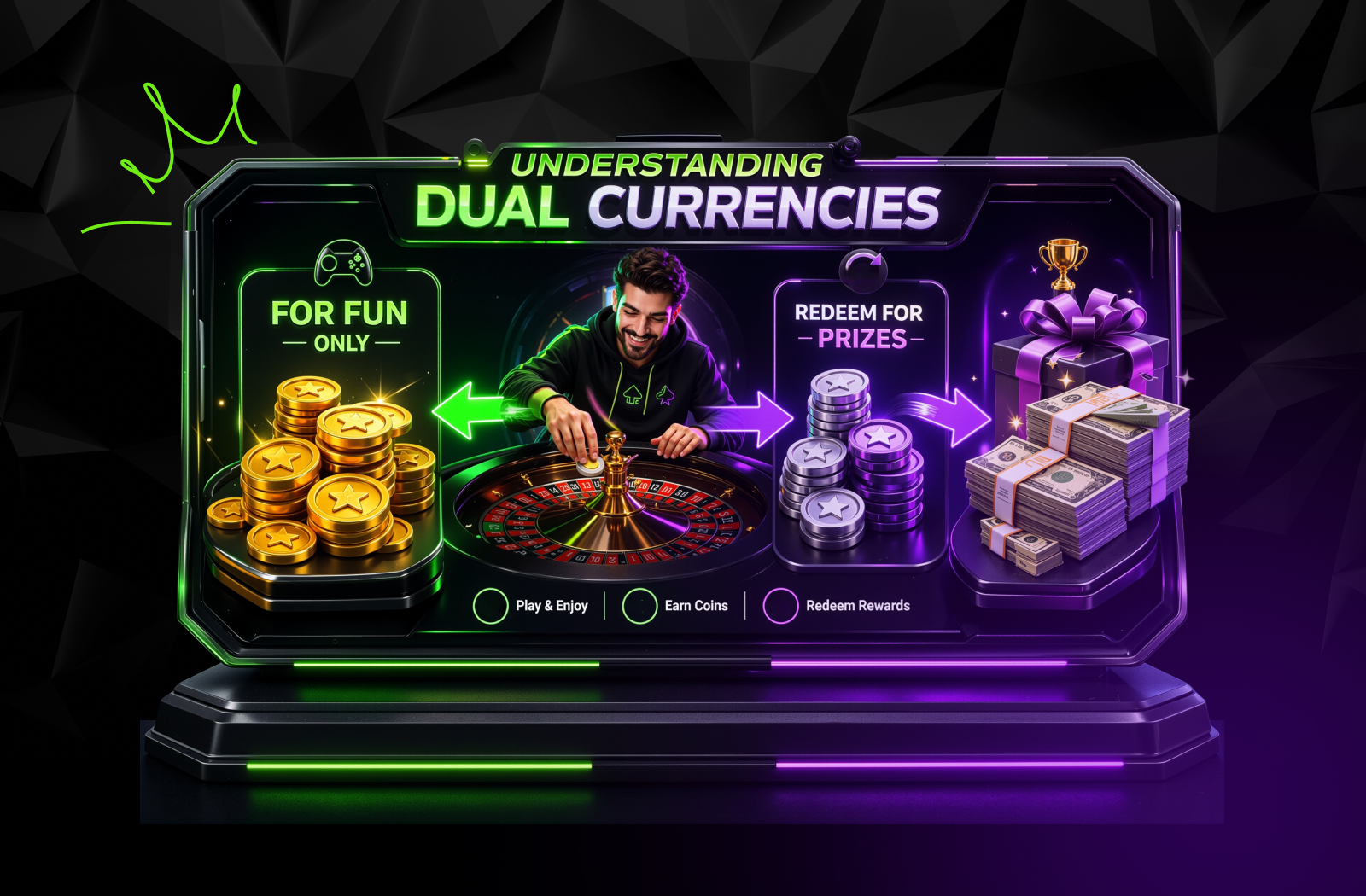
Operators can also brand their currencies differently, but the principle remains consistent across the industry, and it’s absolutely crucial. It means players are never betting or playing real cash, which allows the platforms to operate under different regulatory rules. In reality, the currencies are often mixed (for example, “Buy 1,000 GC for $100 and get 10 SC free”). Players play with GC, and they can get SC as a prize or a bonus.
For a player, earning or buying GC is usually easy. Often, sweepstakes casinos provide generous welcome bonuses upon registration. Daily login rewards and achievement bonuses are also an option. These giveaways engage players and encourage consistent, repeated play.
Players who don’t want to rely only on promotions and daily giveaways can also purchase GC. It’s entirely optional — the platforms must legally allow free play — but it is the primary revenue engine for sweepstakes operators. These packages are typically priced anywhere from a few dollars to several hundred dollars, with common price points between $20 and $50 per transaction.
In marketing terms, Gold Coins are the in-app currency that keeps people interested. Promotions like "daily spins" and "VIP boosters" that award extra GC are common on sweepstakes platforms.
Players can’t buy SC directly on the platform. Here are the primary ways they can earn them:
Sometimes players are awarded with SC for purchasing GC. In sum, Sweeps Coins are earned through a mix of bundled bonuses and free promotions, as required by the rules.
Most platforms require a certain minimum, for example, 50 to 100 Sweeps Coins before redemption is allowed, equivalent to approximately $50 to $100 in prize value.
In most cases, the redemption process involves making a request through the player's account dashboard, choosing a payout method, and going through identity verification to prove eligibility. Different platforms have different ways to pay out, but PayPal, bank transfers, debit cards, and sometimes cryptocurrency are common options. It can take from a few hours to several business days to process.
Players should be aware that sweepstakes casino winnings may be fully taxable income. In the US, Winnings are reported as "Other Income" on IRS Form 1040. If cumulative winnings exceed $600, players typically receive a Form 1099-MISC. Unlike regulated gambling, sweepstakes casinos generally do not issue W-2G forms, but the tax obligation remains.

Sweepstakes casinos represent an impressive market potential combined with broader market accessibility than traditional online casinos.
Let’s analyze all the key reasons:
In summary, what makes sweepstakes casinos relevant for operators is the combination of the best of social games (massive audience and no barriers to play) and the profitable aspects of gambling, with lighter regulations.
In some places, including the markets where online casinos are regulated, sweepstakes casinos are legal. However, there are countries and territories that prohibit sweepstakes casinos or treat them like another online gambling platform.
Sweepstakes casinos are explicitly legal in many countries because theyoperate as promotional contests. The critical point from the legal perspective is “no purchase necessary.” That is, operators must make sure that all promotions provide at least one way for consumers to win prizes without spending any money; therefore, they remain outside the scope of definitions of gambling games.
Sweepstakes are required to have rules, free-entry options, and odds disclosures. They are overseen by consumer-protection authorities rather than gaming commissions. For instance, in the United States the Federal Trade Commission (FTC) would regulate advertising fairness for sweepstakes, not the state gambling board. In the EU, platforms must comply with contest and advertising directives (including data privacy rules).
This legal framework has existed for many years now and has been tested in various court rulings. Products such as McDonald’s Monopoly and magazine sweepstakes have operated under the same legal grounds for many years. The courts have considered what amounts to “consideration” and ruled that where there is a truly free means of entering, it is not gambling even if another paid entry is also an option.
Therefore, with proper implementation, sweepstakes casinos are legal under existing sweepstakes/lottery statutes. No gambling license is necessary, only a regular business/trade license, as there is no gambling with real money. Simply put, the game is considered a skill-of-chance contest, and there is no fee to play.


In 2025, there have been major changes in sweepstakes regulations in the US. Six states passed explicit statutory prohibitions and others implemented strict enforcement measures without formal legislation. Thus, in 2025-2026, sweepstake platforms lost their legal status in New York, California, Montana, Connecticut, and other places.
Nevertheless, in 33 states players still can legally enjoy casino-style games playing with dual currencies.
Outside the US, the legal status of sweepstakes casinos varies. Some nations have legislation that considers any casino game gambling, regardless of whether real money is involved. Others have no legislation on this issue at all. For instance, “sweepstakes slots” have drawn scrutiny in parts of Asia and Europe, while the model exists in a legal gray area. Operators must carefully research each country when entering the market.
As of 2026, sweepstakes casinos are legally permitted in most U.S. states and EU countries such as Italy, Spain, or Germany, however, they often face strong regulatory friction and very specific limitations.
Sweepstakes platforms are different from regulated online casinos in terms of the law and how they operate.
Licensing: Licensed casinos must have a gaming license, proper auditing, responsible gaming measures, and pay gambling taxes. Sweepstakes casinos, as games, need only adhere to consumer protection or advertising regulations. No gaming licenses are required,
nor is there any requirement for any kind of auditing of the RNG process.
Payments: Traditional casinos have to work with high-risk payment processors and face difficulties with most popular payment solutions (both credit cards and PayPal do not allow gambling purchases). Sweepstakes casinos manage this by selling virtual goods: Gold Coins, the virtual fun currency, are perceived as digital goods, not gambling spending. As a result, it is possible to use any regular payment processor, such as Stripe, PayPal, or Apple Pay.
For withdrawals, they mostly use standard payment methods (bank transfers, e-wallets, etc.). Options such as purchasing a gift with Sweeps Coins, such as gift cards, are also common.
Geography: Without real-money gambling, sweepstakes casinos can freely operate in a much wider range of markets without needing a specific license. For example, in the US an operator can target multiple states without any specific permissions. However, regulations can change quickly, so there are still some serious risks to consider.
Taxes: Like other businesses, sweepstakes platforms pay taxes on their income or profits. They don't have to pay any special gambling taxes. They do, however, pay regular sales tax or VAT on coin sales. The result is often a lower effective tax rate than a licensed online casino.
User experience: While playing in a sweepstakes game is quite similar to online casino casino play in terms of gameplay and interface design, there is a major difference in risks. In sweepstakes casinos, Gold Coin play has technically no risk. Many users treat these platforms like lotteries or high-stakes games, while in online casinos there’s a significant risk of losing real money.
Game integrity: Random number generators (RNGs) are commonly used for game outcomes in both models. RNGs must be independently audited and certified for regulated casinos. Although top operators willingly seek third-party certification to increase player trust, sweepstakes casinos are exempt from mandatory audit requirements.
In summary, sweepstakes gambling is easier to operate yet still are highly competitive in revenue. It capitalizes on interest in gambling games with reduced hassle (no need for a license, greater legal acceptance). The table below summarizes key differences between two models:
| Aspect | Sweepstakes Casino (SWS) | Real-Money Casino |
| Regulation | Contest law, no gambling licence | Licensed gambling authority required |
| Payments | Standard processors (coins) | Gambling processors (restricted) |
| Taxation | Standard business tax only | Gaming tax on revenue |
| Geography | Allowed in most places (per contest laws) | Limited to licensed regions |
| Wagering | No real-money wager required | Real-money wagering |
| Prize Payouts | Via SC redemption (controlled) | Cash/games winnings paid out |
| Compliance Costs | Low (no license fees/audits) | High (licenses, audits, RG measures) |
| Player Risk | Free play (low risk) | Real cash risk |
| Monetisation | Selling virtual coins, subs | House edge, rake, fees |
Sweepstakes casino operators must deal with an increasingly complicated compliance burden that requires advanced operational infrastructure. Maintaining the Alternative Method of Entry is the most fundamental compliance requirement. The AMOE needs to be available and actually processed. Operators risk legal and regulatory action if they disregard mail-in requests or set AMOE terms so onerous that they are practically inaccessible. The foundation of the entire legal system is the AMOE; without it, the model devolves into gambling. Constantly changing compliance rules are another significant operational challenge.
Operators usually register as a business under general gaming or marketing laws. Some places now require sweepstakes operators to inform local regulators or apply for a permit if they exceed certain limits, such as the size of prize pools. Because the rules are always changing, it is best to consult gaming attorneys to navigate local jurisdictions.
Even without a specific gambling license, there are many specific rules that sweepstakes casinos must follow to operate as a fully legitimate business. These include strictly following local consumer protection laws, provide transparent rules and terms and conditions, conduct age and location checks, and so on.
Like any gaming platform that deals with large amounts of sensitive data (names, emails, ID documents, payment info), sweepstakes casinos must ensure comprehensive security measures.
Encryption, authentication, and GDPR/CCPA compliance are essential for operators whose platforms cater to international users. Any data breach not only affects the players but also poses legal repercussions.
Moreover, protection from fraud is extremely important. The system is prone to bot and syndicate abuse – automated systems may exploit the daily bonus system or the mail-in entry options, while players may open multiple accounts to earn more SC. However, the contemporary software used for sweepstakes includes protection from such fraudulent activities. Device fingerprinting, CAPTCHA, transaction monitoring, and player behavior analysis with close reviews of suspicious accounts are common antifraud prevention measures.
Selecting the appropriate software platform is the most important decision that the sweepstakes casino owner can make. Technology lays the groundwork for both the gaming experience and compliance in a highly fractured, ever-changing regulatory environment. Operators should evaluate:
Since sweepstakes casinos aren't classified as gambling, they can advertise on social media platforms like Meta, TikTok, and Google where real-money casinos are largely banned — giving them a much cheaper and wider path to new players.
Because anyone can play for free, these platforms easily attract large audiences and gradually convert a portion into paying customers — something traditional casinos, which require a deposit upfront, simply can't replicate.
Keeping players coming back is driven by community features like leaderboards, tournaments, and referral programs, along with VIP tiers that reward loyal players with better bonuses and faster payouts — much like the loyalty programs used by land-based casinos for decades.
To sum up, the most notable advantages of running a sweepstake casino include: lower taxes and fees, lower entry barrier, wider reach and easier expansion, diversification of revenues, and more convenient advertising.
Sweepstakes casinos have come a long way from being an alternative concept to becoming a highly profitable venture worth billions of dollars. By combining the convenience of free-play games with the allure of tangible rewards, they reach a market beyond conventional gambling. In the United States, the market potential for coin-play revenue alone is forecast at more than $10 billion annually, with millions of active users. For operators, this means huge potential even in restricted markets.
Of course, the opportunity comes with responsibility. As scrutiny grows and some areas become stricter, success will depend on staying ahead of compliance requirements. This means having strong KYC processes, protecting players, and running transparent operations. The best operators in this field won't just look for growth; they'll also make trust and flexibility a key part of their business.
The bottom line? Sweepstakes casinos are more than a temporary trend; they're a strong vertical with decades-long traditions that are changing the online gaming landscape. For operators ready to move fast and embrace compliance rules, it is a huge market.
Yes, since sweepstakes casinos fall under contests or promotions laws, they are considered legal in most places. Unlike conventional casino games, which involve making bets using money, sweepstakes games do not require any real money wagers to play.
They make money by selling virtual currency (like gold coins) or offering subscriptions and in-game purchases. The sweepstakes currency is usually given as a bonus, not directly sold.
They can be very profitable if they attract a large user base and maintain strong engagement. hey have relatively lower regulatory and compliance costs than real-money casinos, which could positively contribute to their profit margins.
A dual currency system uses two types of coins: one for gameplay (with no cash value) and another promotional currency that can be redeemed for prizes. This structure helps separate entertainment from prize eligibility.
Yes, players can win real prizes, including cash, through redeeming the promotional currency. However, the process has certain terms and conditions, verification, and minimum redemption thresholds.

